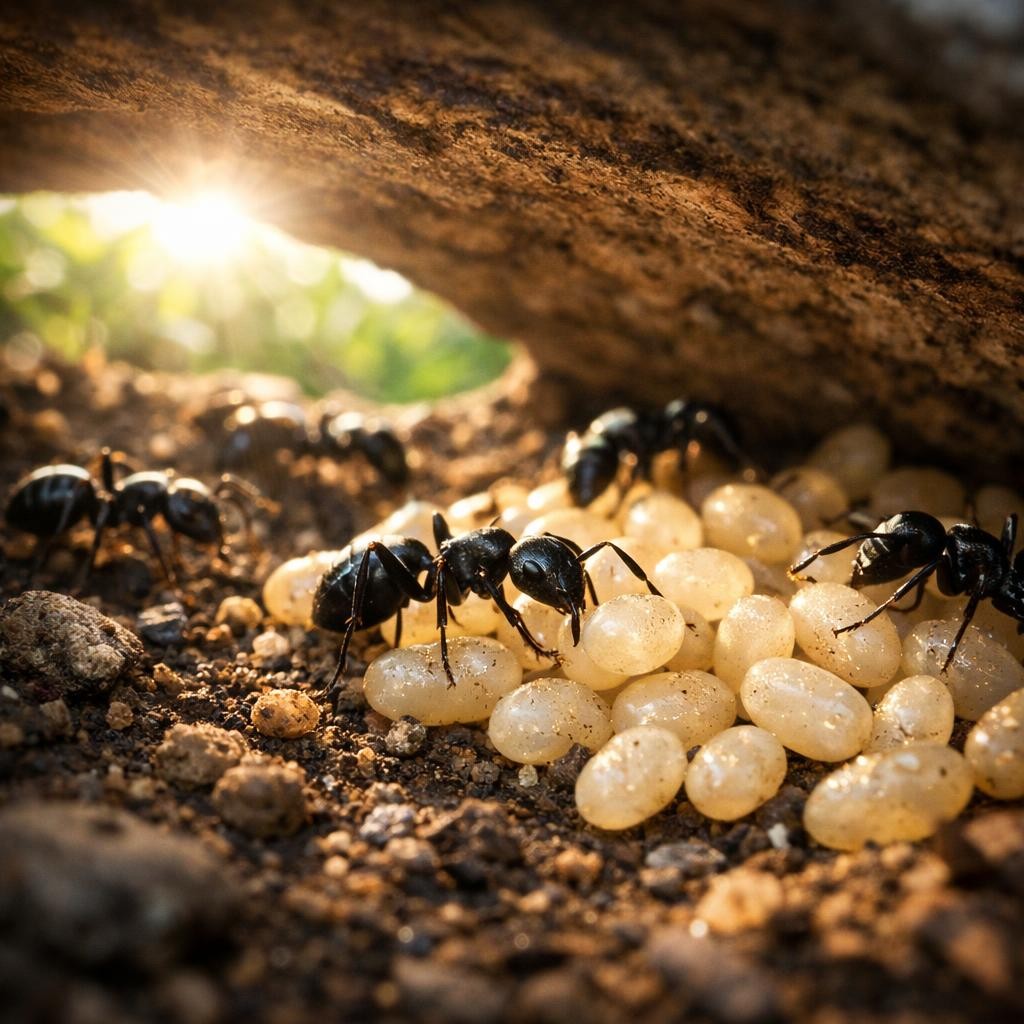
Before I understood ecosystems, before I could name a phylum or describe a food web, I turned over rocks.
Not looking for anything in particular. Just turning them over. The cold, flat undersides. The sudden exposure. What happened next.
Ants.
Every time, or nearly every time, ants. Scrambling in that particular organized panic — purposeful and frantic at once, each one knowing exactly where to go and going there urgently. But it was what they carried that stopped me. The eggs. The larvae. Pale, small, helpless things that could not scramble, could not save themselves. And the ants — creatures with brains smaller than a grain of sand — were already moving them to safety. Before I’d even set the rock down.
It does not take intellect to be caring. It does not take a large brain to love what is vulnerable and act to protect it. The ants taught me that before I had words for it, before I had any framework to place it in. The impulse to protect the not-yet-hatched — the ones who cannot yet speak for themselves — is older than thought. It is written into life at a level far below language.
I would crouch and watch until they’d sorted themselves out, until the new order had reasserted itself over the disruption I’d caused, until the eggs were safe and the colony had closed back around its most vulnerable. Then I’d set the rock back, as carefully as I could. And move to the next one.
I was seven, maybe eight. Ogdensburg, New York. Back yard, farm, it didn’t matter where. The rocks were everywhere and so were the ants.
What I didn’t know then — what I couldn’t have named — was that I was watching emergence. A colony is not a collection of ants. It is something that ants produce when they interact, something that doesn’t live in any individual ant, something that only exists at the level of the whole. There’s no ant in charge. There’s no ant that knows the plan. And yet the plan executes. Every time. And embedded in the plan, non-negotiable, is the protection of those who cannot yet protect themselves.
I’ve spent fifty years in science since those rocks. I’ve pulled sediment cores from Amazonian black-water lagoons. I’ve built algorithms that, in retrospect, seem to have known things before I did. I’ve read enough immunology to understand what kills a person from the inside and enough ecology to understand what keeps a system alive from the outside. And the thing I keep coming back to — the thing that was already present in a seven-year-old crouching over a disrupted colony — is the question of how simple rules produce complex order, and whether the most fundamental of those rules is protection of the vulnerable.

The ants didn’t need to understand the colony to build it. The colony didn’t need a central authority to function. But it needed something else — something older and more basic than intelligence. It needed caring. And it had it.
I think about that when I watch institutions fail. When I watch science get captured. When I watch the thing that’s supposed to protect people become the thing they need protection from. Disruptions happen. The question is always whether the underlying logic — the actual functional relationships, the rules that produce order — is still intact underneath the chaos. Whether the caring is still there. If it is, the system rights itself. If it isn’t, the scrambling never resolves. The eggs get left behind.
The ants taught me to look underneath before I look at the surface. To ask what the system is actually doing before I accept what it claims to be doing. To be patient with apparent chaos, because sometimes apparent chaos is the system correcting for a disruption. And to be alarmed — deeply alarmed — when the scrambling doesn’t move toward the eggs. When the most vulnerable are left exposed.
I still turn over rocks. The rocks just look different now.
You must be logged in to post a comment.